What is the difference between mediation and arbitration?
On this page
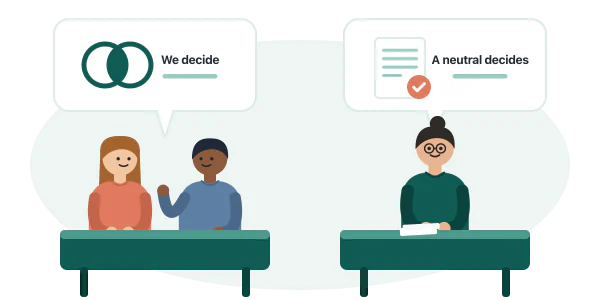
The main difference is who decides. A mediator helps both sides reach their own agreement and has no power to impose a result. An arbitrator hears both sides and makes a decision, which may be nonbinding (either side can reject it and go to trial) or binding (final, with very limited ways to challenge it).
This is general information, not legal advice. Rules vary by state. See how mediation works in your state →
How do mediation and arbitration compare side by side?
Both use a neutral third party instead of a judge, but the neutral's job is different. A mediator helps you negotiate and can't impose anything. An arbitrator runs a hearing and decides. That one difference shapes everything else, from how formal the process is to whether you can challenge the result.
| Mediation | Arbitration | |
|---|---|---|
| Who decides | The parties | The arbitrator or panel |
| The neutral's job | Helps you negotiate; can't impose a result | Hears evidence and arguments, then issues a decision (an award) |
| Can you be forced to accept the outcome? | No | Nonbinding: no. Binding: generally yes |
| Format | Informal discussion and negotiation | A hearing where each side presents its case |
| If there's no deal | The dispute or case goes on | The arbitrator still issues a decision |
| Challenging the result | Nothing to appeal: you only sign what you accept | A binding award can be canceled only on narrow grounds, with short deadlines |
| Can a court require it? | Many courts can order it; rules vary by state | Usually only if you agreed to arbitrate |
| Where you often see it | Divorce, custody, civil lawsuits, workplace charges | Contracts with arbitration clauses |
| Child custody issues | Common, and required in some courts | Some states exclude them |
Federal law describes both as forms of "alternative dispute resolution": processes other than a ruling by a presiding judge, in which a neutral third party helps resolve the issues.1
How does mediation work?
A mediator guides a negotiation. The EEOC says its mediator "does not decide who is right or wrong and has no authority to impose a settlement on the parties."2 Texas law says a mediator "may not impose his own judgment on the issues for that of the parties."3 Even when a court orders mediation, you don't have to settle. If you do, the written agreement you sign can become binding; see is mediation legally binding?
For the basics, see what is mediation?
How does arbitration work?
Arbitration looks more like a simplified trial. Each side presents evidence and arguments to the arbitrator (or a panel), who then issues a decision, often called an award. It is usually less formal than court, but the arbitrator, not the parties, decides the outcome.
Binding vs. nonbinding
- Nonbinding arbitration. The arbitrator's decision is advisory. A party who doesn't accept it can usually reject it and ask for a trial. Some state courts use nonbinding arbitration for certain civil cases. Florida, for example, lets a court refer a contested civil case to nonbinding arbitration, and a party who rejects the decision and then does much worse at trial may have to pay some of the other side's costs and fees.4 Read your court's rules.
- Binding arbitration. The decision is final. Courts can cancel (vacate) a binding award only on narrow grounds set by law. Under the Federal Arbitration Act, for example, the grounds include an award procured by corruption, fraud, or undue means, evident partiality or corruption in the arbitrators, certain arbitrator misconduct, and arbitrators exceeding their powers.5 Deadlines are short: under the same law, notice of a motion to vacate must be served within three months after the award is filed or delivered.6 State arbitration laws have their own lists and deadlines.
Arbitration clauses in contracts
Many contracts, such as employment, consumer, and business agreements, include an arbitration clause. Under the Federal Arbitration Act, a written arbitration provision in a maritime transaction or "a contract evidencing a transaction involving commerce" is "valid, irrevocable, and enforceable," except on grounds that would let someone undo any contract, and except as provided in chapter 4 of the same title.7
Chapter 4 covers sexual assault and sexual harassment disputes. For claims that arise or accrue on or after March 3, 2022, the person making the allegation can choose to have a pre-dispute arbitration agreement treated as not valid or enforceable for that case.8
States also have their own arbitration laws. Whether state law, federal law, or both apply to a particular contract is a legal question.
Tip
Before you sign a contract, look for words like "arbitration," "binding arbitration," or "waiver of jury trial." If you're already in a dispute, find the clause and ask a lawyer what it means for you.
Can a court send you to arbitration?
Usually only if you agreed to arbitrate. If you signed a valid arbitration agreement, a court can usually order you to arbitrate and pause the lawsuit. Some court programs also send certain civil cases to nonbinding arbitration, but federal district courts can require arbitration only when the parties consent.
- If you signed an arbitration agreement, a court can usually order you to arbitrate and pause the lawsuit. Under the Federal Arbitration Act, a federal court must stay a lawsuit over an issue covered by a written arbitration agreement when a party asks, and can order the parties to proceed to arbitration.9
- Court programs. In federal district court, a court that requires dispute resolution in certain cases may require mediation or early neutral evaluation, but may require arbitration only if the parties consent.10 State courts have their own rules, and some send certain civil cases to nonbinding arbitration.
Can family cases be arbitrated?
States limit what can be arbitrated in family law, especially issues about children. Florida's arbitration code, for example, excludes disputes involving child custody, visitation, or child support.11 Mediation of parenting issues, on the other hand, is common and in some states required. See child custody mediation and the Florida divorce mediation guide, which covers Florida's arbitration rules.
Which one fits your situation?
It depends on what you want. Mediation keeps the decision with you and suits disputes where you'll keep dealing with each other. Arbitration gives you a decision from a neutral, usually with less formality than court, and some contracts require it. Some disputes use both: mediation first, then arbitration for whatever is left.
- Mediation may fit when you want control over the outcome, a private conversation, or a chance to preserve a relationship, such as co-parenting or an ongoing business.
- Arbitration may fit when both sides want a neutral decision-maker but a faster or more private process than court, or when a contract requires it.
- Both: some disputes use mediation first and arbitration for whatever is left. Ask a lawyer before agreeing to any binding process.
If a court has already sent your case to mediation, see court-ordered mediation. Browse the mediator directory, find a mediator near you, or get matched.
This is general information, not legal advice.
Not sure who to choose? Get matched
Answer a few short questions. We send your request to mediators who can receive it and handle cases like yours, and they contact you. Free, and you’re never obligated.
Frequently asked questions
Does a mediator or an arbitrator make the decision?
An arbitrator does. A mediator helps the parties negotiate and has no power to impose a result. An arbitrator hears both sides and issues a decision.
Is arbitration always binding?
No. Some arbitration, including some court-ordered programs, is nonbinding: a party can reject the decision and ask for a trial. Binding arbitration produces a decision that is very hard to undo.
Can I appeal an arbitration decision?
Only in limited ways. Laws on binding arbitration usually allow a court to cancel an award only on narrow grounds, such as fraud or an arbitrator exceeding their powers. A lawyer can tell you what applies to your case.
Can a court make me arbitrate?
If you signed a valid arbitration agreement, a court can usually order you to arbitrate. Federal district courts can require mediation in some cases, but can require arbitration only if the parties consent.
Can child custody be arbitrated?
It depends on the state, and some states exclude it. Florida's arbitration laws, for example, exclude child custody, visitation, and child support. Check your state's rules.
Sources
-
28 U.S.C. § 651(a) (2024 ed.), Authorization of alternative dispute resolution — https://www.govinfo.gov/content/pkg/USCODE-2024-title28/html/USCODE-2024-title28-partIII-chap44-sec651.htm ↩
-
U.S. Equal Employment Opportunity Commission, Questions and Answers About Mediation — https://www.eeoc.gov/questions-and-answers-about-mediation ↩
-
Tex. Civ. Prac. & Rem. Code § 154.023(b) (2025), Mediation — https://statutes.capitol.texas.gov/Docs/CP/htm/CP.154.htm#154.023 ↩
-
Fla. Stat. § 44.103 (2026), Court-ordered, nonbinding arbitration — https://www.flsenate.gov/Laws/Statutes/2026/44.103 ↩
-
9 U.S.C. § 10(a) (2024 ed.), U.S. Government Publishing Office — https://www.govinfo.gov/content/pkg/USCODE-2024-title9/html/USCODE-2024-title9-chap1-sec10.htm ↩
-
9 U.S.C. § 12 (2024 ed.), U.S. Government Publishing Office — https://www.govinfo.gov/content/pkg/USCODE-2024-title9/html/USCODE-2024-title9-chap1-sec12.htm ↩
-
9 U.S.C. § 2 (2024 ed.), U.S. Government Publishing Office — https://www.govinfo.gov/content/pkg/USCODE-2024-title9/html/USCODE-2024-title9-chap1-sec2.htm ↩
-
9 U.S.C. §§ 401–402 (2024 ed.) and effective-date note, U.S. Government Publishing Office — https://www.govinfo.gov/content/pkg/USCODE-2024-title9/html/USCODE-2024-title9-chap4-sec402.htm ↩
-
9 U.S.C. §§ 3–4 (2024 ed.), U.S. Government Publishing Office — https://www.govinfo.gov/content/pkg/USCODE-2024-title9/html/USCODE-2024-title9-chap1-sec3.htm ↩
-
28 U.S.C. § 652(a) (2024 ed.), Jurisdiction — https://www.govinfo.gov/content/pkg/USCODE-2024-title28/html/USCODE-2024-title28-partIII-chap44-sec652.htm ↩
-
Fla. Stat. § 682.25 (2026), Disputes excluded — https://www.flsenate.gov/Laws/Statutes/2026/682.25 ↩
Find a mediator near you
Court-verified listings come only from official court and government rosters and link to their source. Prefer a shortlist? Get matched with up to 3 mediators.