Personal injury mediation: is it binding, how long does it take, and when do you get paid?

On this page
Short answer: in Florida, personal injury mediation is not binding unless you choose to settle. If you do reach an agreement, it must be written down and signed, and once that happens the court can enforce it. Florida's court rules set deadlines for mediation, not a typical length. When you get paid depends on the terms of the settlement. Florida law sets a 20-day payment deadline for insurers that agree in writing to settle, and your lawyer has trust account duties before any money reaches you.
This is general information about Florida law, not legal advice. For questions about your own case, ask your lawyer.
What personal injury mediation is
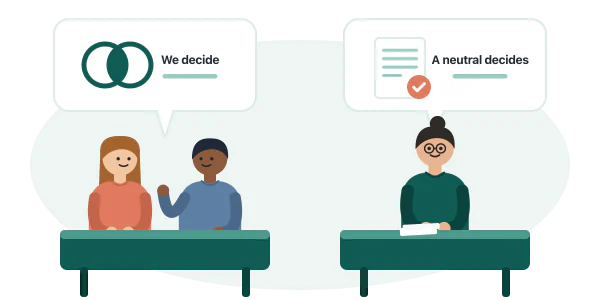
Mediation is a meeting where a neutral person, the mediator, helps the two sides try to settle. Florida law describes it as an "informal and nonadversarial process" in which "decisionmaking authority rests with the parties."1 The mediator does not decide who is at fault and does not set the amount of a settlement.
In a personal injury case, the injured person is usually the plaintiff (the person who sued). The defendant is the person or business being sued. Often the defendant's insurance company is the one paying any settlement.
How a Florida injury case gets to mediation
There are two main ways.
- A party asks for it. Florida law says a court must, at the request of one party, refer a filed civil lawsuit for money damages to mediation, as long as the requesting party is willing and able to pay the costs or the costs can be fairly divided.2 This rule has exceptions. It does not apply to medical malpractice claims, debt collection suits, cases under the small claims rules, or cases where the parties agreed to binding arbitration, among others.2
- The judge orders it, or the parties agree. A judge may refer all or part of a contested civil case to mediation, and the parties can file a written agreement to mediate at any time.3
The referral order or the parties' agreement can allow mediation in person, by video, or a mix of both. If the order says nothing, mediation is held in person unless the parties agree or the court orders otherwise.3
Who has to attend
Florida's civil rules spell out who must be there for a party to count as having "appeared." For a court-ordered mediation, that means:4
- The party, or a party representative who has full authority to settle without checking with anyone else.
- The party's lawyer of record, if there is one.
- For any party that has insurance, a representative of the insurance company who is not the company's outside lawyer and who has full authority to settle up to the plaintiff's last demand or the policy limits, whichever is less, without checking with anyone else.
The rule defines a representative with "full authority to settle" as the final decision maker on all issues in the case who has the legal power to sign a binding settlement for the party.4 Unless the parties agree otherwise, each party must file a notice 10 days before mediation naming who will attend and confirming they have that authority.4
Skipping a properly scheduled mediation without good cause has consequences. The court, on motion, must impose sanctions, which can include mediation fees, attorneys' fees, and costs.4
None of this means you have to settle. The rule says plainly that nothing in it requires a party who attends to enter into a settlement agreement.4
Is it binding?
Attending is not agreeing
At the start of each session, a Florida certified mediator must tell everyone that mediation is a consensual process and that the mediator has no authority to impose a resolution.5 If you do not agree, the mediator reports the lack of agreement to the court "without comment or recommendation."6
A signed agreement is binding
If you settle all or part of the case, the agreement must be written down and signed by each party or a representative with full authority to settle. Signatures can be original or electronic.6 The mediator must report the existence of the signed agreement to the court, without comment, within 10 days.6
If someone later breaks or fails to perform the agreement, the court can, on motion, impose sanctions, including costs, attorneys' fees, or entry of judgment on the agreement.6 If mediation was held by video under the rules, a party cannot object to enforcement because video was used.6
Because a signed agreement can be enforced, read every term before you sign. For background, see what is mediation and is mediation legally binding? If your case was sent to mediation by a judge, see court-ordered mediation.
How long does it take?
Florida's rules set deadlines. They do not set a typical session length, and we do not quote one.
- First session: unless the court orders otherwise, the first mediation conference must be held within 60 days of the referral order.3
- Finishing: mediation must be completed within 45 days of the first conference unless the court or the parties extend it.7
- Breaks and second sessions: the mediator may adjourn at any time and set a time to reconvene, even past the 45-day deadline.4
Mediation does not pause the rest of the case. Unless the parties agree or the court orders otherwise, discovery (the formal exchange of evidence) continues during mediation.7
When do you get paid?
The honest answer is that timing depends on the terms of your settlement agreement. Here is what Florida law and the Florida Bar's rules say.
The insurer's deadline
When a person and an insurer agree in writing to settle a claim, Florida law says the insurer must tender payment according to the terms of the agreement no later than 20 days after the settlement is reached.8 The insurer may condition payment on your signing a release (a document giving up your claims) that both sides find acceptable. If payment is not tendered within 20 days, or by another date the agreement sets, it bears interest at 12 percent per year from the date of the agreement. If payment is conditioned on a release, interest does not start until you hand over the signed release.8
So the agreement itself can set a different date, and signing the release can affect timing. Ask your lawyer what your agreement says.
What your lawyer must do with the money
Settlement money often goes first to your lawyer's trust account. The Florida Bar's rules then apply:
- Prompt notice and delivery. A lawyer who receives funds in which a client has an interest must promptly notify the client and, except as the rules or law allow or the client agrees, must promptly deliver the funds the client is entitled to.9
- The funds must clear. With limited exceptions, a lawyer may not pay out funds held for a client until they are "collected funds," meaning deposited, finally settled, and credited to the trust account.9
- Disputed amounts are held back. If two or more people claim part of the money, the disputed portion must be kept separate until the dispute is resolved. The lawyer must promptly pay out the portions that are not in dispute.9
The closing statement
Most injury lawyers work on a contingent fee, meaning the fee is a share of what you recover. Florida's rules require that, when there is a recovery, the lawyer prepare a closing statement itemizing all costs and expenses and each lawyer's fee, signed by you and the lawyers.10 The Florida Bar's Statement of Client's Rights for contingency fees tells clients they have the right to receive and approve a closing statement before paying any money, and that until the client approves it, the lawyer cannot pay any money to anyone, including the client, without a court order.10
The same statement says that you, the client, make the final decision to accept or reject a settlement.10
Is what I say confidential?
Generally, yes. Under Florida law, mediation communications are confidential, and each party has a privilege to refuse to testify, and to stop others from testifying, about them in a later proceeding.11 There are exceptions, for example threats of violence or evidence offered to void or reform a settlement agreement on legally recognized grounds.11 A signed written settlement agreement is not confidential unless the parties agree otherwise.11
Evidence that is otherwise available, such as medical records, does not become protected just because it was used in mediation.11
Before you go
- Talk with your lawyer about your goals and your lowest acceptable number.
- Ask who will attend for the insurance company and confirm they have the authority the rule requires.4
- Ask how any settlement money will be paid, and when, and what liens or other claims might be paid from it.
- If the accident involved a car, see our guide to car accident mediation for what the day looks like.
Find a Florida certified mediator in our Florida directory, or get matched with one who fits your case.
Not sure who to choose? Get matched
Answer a few short questions. We send your request to mediators who can receive it and handle cases like yours, and they contact you. Free, and you’re never obligated.
Frequently asked questions
Is personal injury mediation binding in Florida?
The mediation itself is not binding. Nobody has to settle. But if you reach an agreement and it is written down and signed by each party or a representative with full authority to settle, the court can enforce it, including by entering judgment on it.
Can I ask the court to send my injury case to mediation?
Yes, in most cases. Florida law says a court must refer a filed civil lawsuit for money damages to mediation when one party asks, as long as that party is willing and able to pay the mediation costs or the costs can be fairly divided. There are exceptions, including medical malpractice cases and small claims cases.
How long does personal injury mediation take?
Florida's civil rules set deadlines, not a typical length. Unless the court orders otherwise, the first mediation conference must be held within 60 days of the referral order, and mediation must be completed within 45 days of the first conference unless the court or the parties extend it. The mediator can also adjourn and reconvene.
When do I get my settlement money?
It depends on the terms of your settlement agreement. Florida law requires an insurer that agrees in writing to settle a claim to tender payment by the terms of the agreement no later than 20 days after the settlement is reached, and payment can be conditioned on your signing a release. Your lawyer then has to follow trust account rules before paying you. Ask your lawyer for a timeline.
Does the insurance company have to come to mediation?
In a Florida court-ordered mediation, an insured party is not considered to have appeared unless a representative of the insurance carrier attends who is not the carrier's outside counsel and has full authority to settle up to the plaintiff's last demand or the policy limits, whichever is less.
Can what I say in mediation be used against me in court?
Generally no. Florida law makes mediation communications confidential and gives each party a privilege to keep them out of later court proceedings, with specific exceptions. A signed settlement agreement is not confidential unless the parties agree otherwise.
Sources
-
Fla. Stat. § 44.1011(2) (2026) (definition of "mediation"). https://www.flsenate.gov/Laws/Statutes/2026/44.1011 ↩
-
Fla. Stat. § 44.102(2)(a) (2026) (court-ordered mediation; referral on request). https://www.flsenate.gov/Laws/Statutes/2026/44.102 ↩ ↩2
-
Fla. R. Civ. P. 1.700(a), (a)(1) (referral; in-person or communication technology; first conference within 60 days). https://www-media.floridabar.org/uploads/2026/10/Civil-Procedure-Rules-10-01-26.pdf ↩ ↩2 ↩3
-
Fla. R. Civ. P. 1.720(b), (c), (e), (f), (g) (appearance, including insurance carrier representative; full authority to settle; certification of authority; sanctions; adjournments). https://www-media.floridabar.org/uploads/2026/10/Civil-Procedure-Rules-10-01-26.pdf ↩ ↩2 ↩3 ↩4 ↩5 ↩6 ↩7
-
Florida Rules for Certified and Court-Appointed Mediators, Rule 10.420(a) (orientation session). https://flcourts-media.flcourts.gov/content/download/1998036/file/FRC&CAM_01.2025%20ADA.pdf ↩
-
Fla. R. Civ. P. 1.730(a)–(d) (no agreement; agreement in writing and signed; enforceability; sanctions). https://www-media.floridabar.org/uploads/2026/10/Civil-Procedure-Rules-10-01-26.pdf ↩ ↩2 ↩3 ↩4 ↩5
-
Fla. R. Civ. P. 1.710(a), (c) (completion within 45 days; discovery not suspended). https://www-media.floridabar.org/uploads/2026/10/Civil-Procedure-Rules-10-01-26.pdf ↩ ↩2
-
Fla. Stat. § 627.4265 (2026) (payment of settlement). https://www.flsenate.gov/Laws/Statutes/2026/627.4265 ↩ ↩2
-
Rules Regulating The Florida Bar, Rule 5-1.1(e), (f), (j) (notice and delivery of trust funds; disputed ownership; disbursement against uncollected funds), October 1, 2026 edition. https://www-media.floridabar.org/uploads/2026/10/2027_04-OCT-Chapter-5-RRTFB.pdf ↩ ↩2 ↩3
-
Rules Regulating The Florida Bar, Rule 4-1.5(f)(4)–(5) and Statement of Client's Rights for Contingency Fees, items 8 and 10, October 1, 2026 edition. https://www-media.floridabar.org/uploads/2026/10/2027_04-OCT-Chapter-4-RRTFB.pdf ↩ ↩2 ↩3
-
Fla. Stat. § 44.405(1), (2), (4)(a), (5) (2026) (confidentiality; privilege; exceptions). https://www.flsenate.gov/Laws/Statutes/2026/44.405 ↩ ↩2 ↩3 ↩4
Find a court-certified mediator in Florida →
Find a mediator near you
Court-verified listings come only from official court and government rosters and link to their source. Prefer a shortlist? Get matched with up to 3 mediators.