
Divorce laws by state
Waiting periods, residency, no-fault grounds, property and custody mediation in every state and DC, quoted from each state’s own statutes and court rules.
What is the divorce waiting period in each state?
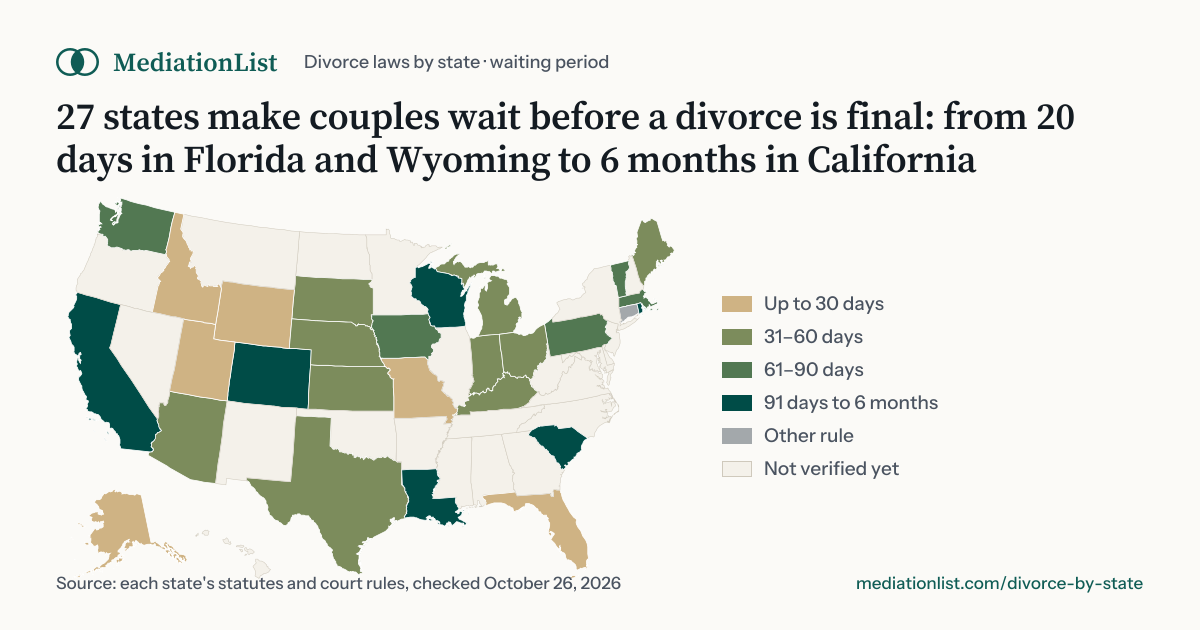
Of the 27 states whose waiting period we’ve verified from the statute, 27 make couples wait before a divorce is final, from 20 days to 6 months.[1–45] The most common residency rule is 6 months before filing (13 of 44 verified states).
Key facts
| States with a waiting period | 27 of 27 verified · by state ↓ |
|---|---|
| Most common residency rule | 6 months · 13 of 44 verified |
| No-fault divorce available | 41 of 41 verified · 13 no-fault only |
| Community property | 9 of 40 verified · 4 more let couples opt in |
| Mediation required in custody disputes | 13 of 36 verified |
Each count comes from the state rows in the table below, each cited to that state’s statute or court rule (listed under Sources). Statutes last checked October 26, 2026.
27 states make couples wait before a divorce is final: from 20 days in Florida and Wyoming to 6 months in California
The shortest time the law allows between filing (or service) and a final divorce. Some states wait longer when there are minor children. Connecticut: another rule, see its page.
- Up to 30 days
- 31–60 days
- 61–90 days
- 91 days to 6 months
- Other rule
- Not verified yet
Tap a state to see its rule; tap again to open its page.
Of 51 (50 states + DC): Up to 30 days 6 · 31–60 days 10 · 61–90 days 5 · 91 days to 6 months 6 · Other rule 1 · not verified yet 23.
Source: each state's statutes and court rules, quoted and linked on every state page.
Data as of (version 2026.10.28)What changedStatutes and court rules as checked on that date. Not legal advice.
Data as of = when the sources were read · Version = the data release · Page updated = the last change to this page
Divorce waiting periods and rules by state
“—” means not verified from an official source yet; each state page links to where to look. Verified so far, of 51: waiting period 28 · residency requirement 44 · no-fault divorce 41 · property division 40 · court mediation for custody 36.
On phones this list shows each state’s waiting period and residency rule; open a state for all of its rules.
| State | Waiting period | Residency requirement | No-fault divorce | Property division | Court mediation for custody | Mediators per 100k |
|---|---|---|---|---|---|---|
| Alabama[1] | — | 6 months (when the other spouse is a nonresident) | — | — | — | 10.9 |
| Alaska[2] | 30 days | No minimum period (must be a resident) | No-fault or fault | Equitable distribution (community property by agreement) | Court may order | 5.3 |
| Arizona[3] | 60 days | 90 days | No-fault or fault | Community property (divided equitably) | — | 0.5 |
| Arkansas | — | — | — | — | — | 5.7 |
| California[4] | 6 months | 6 months (state) + 3 months (county) | No-fault available | Community property | Required | 5.1 |
| Colorado[5] | 91 days | 91 days | — | — | Court may order | 1.0 |
| Connecticut[6] | 90 days (contested trial only) | 12 months (to finalize) | No-fault or fault | Equitable distribution (court assigns by statutory factors) | — | 0.8 |
| Delaware[7] | — | 6 months | No-fault or fault * | Equitable distribution | Normally required (Family Court refers) | 4.7 |
| District of Columbia | — | — | — | — | — | 4.4 |
| Florida[8] | 20 days | 6 months | Only no-fault | Equitable distribution (community property trust by choice) | Required where a program exists | 27.7 |
| Georgia[9] | — | 6 months | No-fault or fault | — | Court may order | 28.8 |
| Hawaii | — | — | — | — | — | 7.3 |
| Idaho[10] | 21 days | 6 weeks | No-fault or fault | Community property | Court may order | 11.8 |
| Illinois[11] | — | 90 days | Only no-fault | Equitable distribution | Required (unless an impediment exists) | 9.4 |
| Indiana[12] | 60 days | 6 months (state) + 3 months (county) | — | — | Court may order | 15.1 |
| Iowa[13] | 90 days | 1 year (unless respondent is an Iowa resident served in person) | Only no-fault | Equitable distribution | Court may order | 9.9 |
| Kansas[14] | 60 days | 60 days | No-fault or fault | Equitable distribution | Court may order | 8.4 |
| Kentucky[15] | 60 days | 180 days | Only no-fault * | Equitable distribution (community property trust opt-in) | Court may order | — |
| Louisiana[16] | 180 days (365 days with minor children) | Domicile in Louisiana at filing | No-fault or fault * | Community property | Court may order | 1.6 |
| Maine[17] | 60 days | 6 months | No-fault or fault | Equitable distribution | Required | 4.3 |
| Maryland[18] | — | 6 months (if grounds arose outside Maryland) | Only no-fault | Equitable distribution (monetary award) | Court must screen; orders mediation if appropriate | 5.8 |
| Massachusetts[19] | 90 days after judgment nisi (plus earlier delays) | 1 year (if the cause arose outside MA) | No-fault or fault | Equitable distribution | — | 0.9 |
| Michigan[20] | 60 days (6 months with minor children) | 180 days (and 10 days in the county) | Only no-fault | Equitable distribution | Court may order | 4.7 |
| Minnesota[21] | — | 180 days | Only no-fault | Equitable distribution | Required (ADR, statewide rule) | 15.0 |
| Mississippi[22] | — | — | No-fault or fault | — | — | — |
| Missouri[23] | 30 days | 90 days | Only no-fault | Equitable distribution | Court may order | 4.2 |
| Montana[24] | — | 90 days | Only no-fault | Equitable distribution | Court may order | 7.3 |
| Nebraska[25] | 60 days | 1 year | No-fault available | Equitable distribution | Required | 8.3 |
| Nevada[26] | — | 6 weeks | No-fault or fault | Community property | Required in larger counties | 3.6 |
| New Hampshire[27] | — | 1 year (with exceptions) | No-fault or fault | Equitable distribution (equal presumed) | Court may order | 4.5 |
| New Jersey[28] | — | 1 year (except adultery) | No-fault or fault | Equitable distribution | — | 10.4 |
| New Mexico[29] | — | 6 months | No-fault or fault | Community property | Required when feasible | — |
| New York | — | — | — | — | — | 4.1 |
| North Carolina[30] | — | 6 months | No-fault available * | Equitable distribution (equal presumed) | Required | 14.5 |
| North Dakota[31] | — | 6 months | No-fault or fault | Equitable distribution | Required (statewide program) | 8.8 |
| Ohio[32] | 42 days | 6 months | — | Equitable distribution | — | 1.5 |
| Oklahoma | — | — | — | — | — | 0.3 |
| Oregon[33] | — | 6 months | Only no-fault | Equitable distribution | Orientation required; mediation offered | 3.1 |
| Pennsylvania[34] | 90 days | 6 months | No-fault or fault | Equitable distribution | Court may order orientation | 6.7 |
| Rhode Island[35] | 3 months after decision | 1 year | No-fault or fault | Equitable distribution | Court may order | — |
| South Carolina[36] | 3 months | 1 year (3 months if both reside in SC) | No-fault or fault * | Equitable apportionment | — | 18.1 |
| South Dakota[37] | 60 days | Resident at filing | No-fault or fault | Equitable distribution | Required | 11.9 |
| Tennessee | — | — | — | — | — | 18.1 |
| Texas[38] | 60 days | 6 months | No-fault or fault | Community property | Court may order | 2.6 |
| Utah[39] | 30 days | 90 days (county) | No-fault or fault | Equitable distribution | Required | 6.4 |
| Vermont[40] | 90 days after decree | 6 months to file; 1 year to finalize | No-fault or fault * | Equitable distribution | Court may order | 6.8 |
| Virginia[41] | — | 6 months | No-fault or fault * | Equitable distribution | Orientation referral in appropriate cases | 5.8 |
| Washington[42] | 90 days | Resident at filing | Only no-fault | Community property | Court may order | 2.9 |
| West Virginia[43] | — | 1 year (none if married in WV) | No-fault or fault | Equitable distribution (equal division) | Required | 3.7 |
| Wisconsin[44] | 120 days | 6 months | Only no-fault | Community (marital) property | Required (first session) | 0.8 |
| Wyoming[45] | 20 days | 60 days | Only no-fault | Equitable distribution | — | — |
* The no-fault ground requires a period of living apart; the state page has the exact rule. Mediators per 100k: “—” = fewer than 10 listings or the roster is still coming. U.S. rate: 8.3. Same numbers as mediator statistics.
Quick answers
Which states are community property states?
Arizona, California, Idaho, Louisiana, Nevada, New Mexico, Texas, Washington and Wisconsin divide marital property as community property under their statutes; Alaska, Florida, Kentucky and South Dakota let couples opt in by agreement. The other 27 states we’ve verified use equitable distribution; 11 aren’t verified yet.
Which states are no-fault divorce states?
All 41 states we’ve verified allow a divorce without proving fault. Florida, Illinois, Iowa, Kentucky, Maryland, Michigan, Minnesota, Missouri, Montana, Oregon, Washington, Wisconsin and Wyoming have only no-fault grounds; most others also keep fault grounds such as adultery or cruelty. No-fault divorce states map →
How long does a divorce take?
Statutes set a minimum, not a total: after the waiting period, timing depends on whether you agree and on the court’s calendar. Every state we’ve verified so far (27) sets a minimum wait, from 20 days in Florida to 6 months in California; some set a longer one when there are minor children (see each state page).
How much does a divorce cost?
Costs are the court filing fee, any court mediation fee, and lawyer or mediator fees, which vary. We list a fee only where a statute, court rule or fee schedule states it: see each state page. For mediator fees posted by courts, try the divorce mediation cost calculator.
Divorce in your state
- Alabama
- Alaska
- Arizona
- Arkansas
- California
- Colorado
- Connecticut
- Delaware
- District of Columbia
- Florida
- Georgia
- Hawaii
- Idaho
- Illinois
- Indiana
- Iowa
- Kansas
- Kentucky
- Louisiana
- Maine
- Maryland
- Massachusetts
- Michigan
- Minnesota
- Mississippi
- Missouri
- Montana
- Nebraska
- Nevada
- New Hampshire
- New Jersey
- New Mexico
- New York
- North Carolina
- North Dakota
- Ohio
- Oklahoma
- Oregon
- Pennsylvania
- Rhode Island
- South Carolina
- South Dakota
- Tennessee
- Texas
- Utah
- Vermont
- Virginia
- Washington
- West Virginia
- Wisconsin
- Wyoming
Use this map
Free to reuse under CC BY 4.0. Required attribution: MediationList.com
, with a link to this page.
The embed shows the waiting-period map as an image linked back here.
Sources
Each state’s statutes and court rules, read on the official site; one entry per state, with the latest date we checked that state.
- Alabama: Residency requirement: Ala. Code § 30-2-5, as quoted by the Alabama Court of Civil Appeals (opinion on acis.alabama.gov)↩
- Alaska: Waiting period, Residency requirement: Alaska Court System Self-Help Center, "Start a divorce or dissolution case"; No-fault divorce, Property division: AS 25.24.050 and AS 25.24.200 (Alaska Legislature); Court mediation for custody: AS 25.20.080 (Alaska Legislature)↩
- Arizona: Waiting period: A.R.S. § 25-329 (Arizona Legislature); Residency requirement, No-fault divorce: A.R.S. § 25-312(A)(1) (Arizona Legislature); Property division: A.R.S. § 25-318(A) (Arizona Legislature)↩
- California: Waiting period: Judicial Branch of California self-help guide, "The divorce process" and "Joint petition" (California Courts Self-Help Guide); Residency requirement, No-fault divorce: Judicial Branch of California self-help guide, "Divorce in California" (California Courts Self-Help Guide); Property division: Judicial Branch of California self-help guide, "Property and debts" (California Courts Self-Help Guide); Court mediation for custody: Judicial Branch of California self-help guide, "Ask for custody and visitation orders" (California Courts Self-Help Guide)↩
- Colorado: Waiting period, Court mediation for custody: Colorado Judicial Branch, JDF 1010 "How to File for Divorce or Legal Separation"; Residency requirement: Colorado Judicial Branch, "Divorce or Legal Separation" self-help page↩
- Connecticut: Waiting period, Residency requirement, No-fault divorce, Property division: Conn. Gen. Stat. § 46b-67(a) (Connecticut General Assembly)↩
- Delaware: Residency requirement, No-fault divorce, Property division: 13 Del. C. § 1504(a) (Delaware Code Online); Court mediation for custody: Family Court of the State of Delaware, Custody page (Delaware Courts)↩
- Florida: Waiting period: Fla. Stat. § 61.19 (Online Sunshine, Florida Legislature); Residency requirement: Fla. Stat. § 61.021 (Online Sunshine, Florida Legislature); No-fault divorce: Fla. Stat. § 61.052 (Online Sunshine, Florida Legislature); Property division: Fla. Stat. § 61.075 (Online Sunshine, Florida Legislature); Court mediation for custody: Fla. Stat. § 44.102(2)(c) (Online Sunshine, Florida Legislature)↩
- Georgia: Residency requirement, No-fault divorce: Judicial Council of Georgia / georgiacourts.gov, "Instructions for Complaint for Divorce Without Minor Children" (April 2024); Court mediation for custody: Supreme Court of Georgia ADR Rules, Appendix A, Rule 2(B) (Georgia Office of Dispute Resolution)↩
- Idaho: Waiting period: Idaho Code § 32-716 (Idaho Legislature); Residency requirement: Idaho Code § 32-701 (Idaho Legislature); No-fault divorce: Idaho Code § 32-603 and § 32-616 (Idaho Legislature); Property division: Idaho Code § 32-712(1) (Idaho Legislature); Court mediation for custody: Idaho R. Fam. L. P. 602 (Idaho Supreme Court)↩
- Illinois: Residency requirement, No-fault divorce: 750 ILCS 5/401(a) (Illinois General Assembly); Property division: 750 ILCS 5/503(d) (Illinois General Assembly); Court mediation for custody: Ill. S. Ct. R. 905(b) (Illinois Supreme Court Rules, full PDF from illinoiscourts.gov)↩
- Indiana: Waiting period, Residency requirement: Parke County, Indiana (in.gov), "To file for divorce in Indiana"; Court mediation for custody: Indiana Rules for Alternative Dispute Resolution, Rule 2.2 (Indiana Supreme Court)↩
- Iowa: Waiting period: Iowa Code § 598.19 (Iowa Legislature); Residency requirement: Iowa Code § 598.5(1)(k) (Iowa Legislature); No-fault divorce: Iowa Code § 598.17 (Iowa Legislature); Property division: Iowa Code § 598.21(5) (Iowa Legislature); Court mediation for custody: Iowa Code § 598.7(1) and § 598.41 (Iowa Legislature)↩
- Kansas: Waiting period: K.S.A. 23-2708 (Kansas Legislature); Residency requirement: K.S.A. 23-2703 (Kansas Legislature); No-fault divorce: K.S.A. 23-2701(a) (Kansas Legislature); Property division: K.S.A. 23-2802 (Kansas Legislature); Court mediation for custody: K.S.A. 23-3502(a) (Kansas Legislature)↩
- Kentucky: Waiting period: KRS 403.044 (Kentucky General Assembly); Residency requirement, No-fault divorce: KRS 403.140(1)(a) (Kentucky General Assembly); Property division: KRS 403.190(1) (Kentucky General Assembly); Court mediation for custody: FCRPP 39(1)-(2), adopted by Kentucky Supreme Court Order 2022-58 (eff. Jan. 1, 2023); KRS 403.036↩
- Louisiana: Waiting period: La. Civ. Code arts. 102 and 103.1 (Louisiana State Legislature); Residency requirement: La. Code Civ. Proc. art. 10(A)(7) and 10(B) (Louisiana State Legislature); No-fault divorce: La. Civ. Code arts. 103 and 103.1 (Louisiana State Legislature); Property division: La. Civ. Code art. 2336; La. R.S. 9:2801(A)(4)(b) (Louisiana State Legislature); Court mediation for custody: La. R.S. 9:332(A); La. R.S. 9:363 (Louisiana State Legislature)↩
- Maine: Waiting period: Divorce (State of Maine Judicial Branch); Residency requirement: 19-A M.R.S. § 901(1) (Maine Legislature); No-fault divorce: 19-A M.R.S. § 902(1)(H) (Maine Legislature); Property division: 19-A M.R.S. § 953(1) (Maine Legislature); Court mediation for custody: 19-A M.R.S. § 251(2) (Maine Legislature)↩
- Maryland: Residency requirement: Md. Code, Family Law § 7-101 (Maryland General Assembly); No-fault divorce: Md. Code, Family Law § 7-103(a) (Maryland General Assembly); Property division: Md. Code, Family Law § 8-205(a)(1) (Maryland General Assembly); Court mediation for custody: Md. Rule 9-205(b) (copy published by the Maryland Judiciary, mdcourts.gov)↩
- Massachusetts: Waiting period: Mass. Gen. Laws c. 208, § 21 (Massachusetts Legislature); also §§ 1A and 1B; Waiting period: Mass. Gen. Laws ch. 208, § 1B; Residency requirement: Mass. Gen. Laws c. 208, § 5 (Massachusetts Legislature); see also § 4; No-fault divorce: Mass. Gen. Laws c. 208, § 1 (Massachusetts Legislature); Property division: Mass. Gen. Laws c. 208, § 34 (Massachusetts Legislature)↩
- Michigan: Waiting period: MCL 552.9f (Michigan Legislature); Residency requirement: MCL 552.9(1) (Michigan Legislature); No-fault divorce: MCL 552.6(1) (Michigan Legislature); Property division: MCL 552.19 (Michigan Legislature); see also MCL 552.23(1); Court mediation for custody: MCL 552.513(1), (3) (Michigan Legislature)↩
- Minnesota: Residency requirement: Minn. Stat. § 518.07, subd. 1 (Minnesota Revisor of Statutes); No-fault divorce: Minn. Stat. § 518.06, subd. 1; § 518.13, subd. 2 (Minnesota Revisor of Statutes); No-fault divorce: Minn. Stat. § 518.13; Property division: Minn. Stat. § 518.58, subd. 1 (Minnesota Revisor of Statutes); Court mediation for custody: Minn. Gen. R. Prac. 310.01 (Minnesota Revisor of Statutes, court rules); Minn. Stat. § 518.619↩
- Mississippi: No-fault divorce: Uniform Chancery Court Rules 8.03 and 8.04 (Mississippi Judiciary, rev. Apr. 18, 2024)↩
- Missouri: Waiting period, Residency requirement, No-fault divorce: RSMo § 452.305.1(1) (Missouri Revisor of Statutes; version effective Aug. 28, 2026); No-fault divorce: RSMo § 452.320; Property division: RSMo § 452.330.1 (Missouri Revisor of Statutes); Court mediation for custody: RSMo § 452.372.2 and .4 (Missouri Revisor of Statutes)↩
- Montana: Residency requirement, No-fault divorce: Mont. Code Ann. § 40-4-104(1)(a) (Montana Legislature, MCA 2025); Property division: Mont. Code Ann. § 40-4-202(1) (Montana Legislature, MCA 2025); Court mediation for custody: Mont. Code Ann. § 40-4-301 (Montana Legislature, MCA 2025)↩
- Nebraska: Waiting period: Neb. Rev. Stat. § 42-363 (Nebraska Legislature); Residency requirement: Neb. Rev. Stat. § 42-349 (Nebraska Legislature); No-fault divorce: Neb. Rev. Stat. § 42-361 (Nebraska Legislature); Property division: Neb. Rev. Stat. § 42-365 (Nebraska Legislature); Court mediation for custody: Neb. Rev. Stat. § 43-2937(3)-(4) (Nebraska Legislature)↩
- Nevada: Residency requirement, No-fault divorce, Property division: NRS 125.020(2) (Nevada Legislature); Court mediation for custody: NRS 3.475 and 3.500 (Nevada Legislature)↩
- New Hampshire: Residency requirement: N.H. Rev. Stat. Ann. § 458:5 (New Hampshire General Court); No-fault divorce: N.H. Rev. Stat. Ann. § 458:7-a (New Hampshire General Court); see § 458:7; Property division: N.H. Rev. Stat. Ann. § 458:16-a(II) (New Hampshire General Court); Court mediation for custody: N.H. Rev. Stat. Ann. § 461-A:7(III)-(V) (New Hampshire General Court)↩
- New Jersey: Residency requirement: N.J.S.A. 2A:34-10 (New Jersey Legislature statutes database); No-fault divorce: N.J.S.A. 2A:34-2(i) and (d) (New Jersey Legislature statutes database); Property division: N.J.S.A. 2A:34-23(h) (New Jersey Legislature statutes database)↩
- New Mexico: Residency requirement, No-fault divorce, Property division, Court mediation for custody: NMSA 1978, § 40-4-5 (NMOneSource, New Mexico Compilation Commission, unannotated Chapter 40)↩
- North Carolina: Residency requirement: N.C. Gen. Stat. § 50-8 (North Carolina General Assembly); see also § 50-6; No-fault divorce: N.C. Gen. Stat. § 50-6 (North Carolina General Assembly); Property division: N.C. Gen. Stat. § 50-20(a), (c) (North Carolina General Assembly); Court mediation for custody: N.C. Gen. Stat. § 50-13.1(b)-(c); § 7A-494 (North Carolina General Assembly)↩
- North Dakota: Residency requirement, No-fault divorce, Property division: N.D.C.C. § 14-05-17 (North Dakota Legislative Branch); Court mediation for custody: N.D.R.Ct. 8.1(c) (North Dakota Court System)↩
- Ohio: Waiting period: Ohio Civ.R. 75(K) (Supreme Court of Ohio, Rules of Civil Procedure); Residency requirement: R.C. 3105.03 as stated in Barth v. Barth, 2007-Ohio-973 (Supreme Court of Ohio); Property division: R.C. 3105.171(C)(1) as quoted in Shupe v. Shupe, 2017-Ohio-5864 (Ohio 5th Dist. Ct. App., Supreme Court of Ohio opinions site)↩
- Oregon: Residency requirement, No-fault divorce, Property division, Court mediation for custody: ORS 107.075(2) (Oregon State Legislature)↩
- Pennsylvania: Waiting period, No-fault divorce: 23 Pa.C.S. § 3301(c) (Pennsylvania General Assembly); Residency requirement: 23 Pa.C.S. § 3104(b) (Pennsylvania General Assembly); Property division: 23 Pa.C.S. § 3502(a) (Pennsylvania General Assembly); Court mediation for custody: 23 Pa.C.S. § 3901(b)-(c) (Pennsylvania General Assembly)↩
- Rhode Island: Waiting period: R.I. Gen. Laws § 15-5-23(a) (State of Rhode Island General Assembly); Residency requirement: R.I. Gen. Laws § 15-5-12(a) (State of Rhode Island General Assembly); No-fault divorce: R.I. Gen. Laws § 15-5-3.1(a) (State of Rhode Island General Assembly); Property division: R.I. Gen. Laws § 15-5-16.1 (State of Rhode Island General Assembly); Court mediation for custody: R.I. Gen. Laws § 15-5-29(a) (State of Rhode Island General Assembly)↩
- South Carolina: Waiting period, Residency requirement, No-fault divorce, Property division: S.C. Code § 20-3-80 (South Carolina Legislature)↩
- South Dakota: Waiting period: SDCL § 25-4-34 (South Dakota Legislature); Residency requirement: SDCL § 25-4-30 (South Dakota Legislature); No-fault divorce: SDCL §§ 25-4-2, 25-4-17.1 (South Dakota Legislature); Property division: SDCL § 25-4-44 (South Dakota Legislature); Court mediation for custody: SDCL § 25-4-56 (South Dakota Legislature)↩
- Texas: Waiting period, Residency requirement, No-fault divorce: Tex. Fam. Code § 6.702 (Texas Constitution and Statutes); Property division: Tex. Fam. Code § 7.001; § 3.002 (Texas Constitution and Statutes); Court mediation for custody: Tex. Fam. Code § 153.0071(c), (f) (Texas Constitution and Statutes)↩
- Utah: Waiting period, Residency requirement: Utah Code § 81-4-402(3)(a) (Utah State Legislature); No-fault divorce, Property division, Court mediation for custody: Utah Code § 81-4-405(1)(h) (Utah State Legislature)↩
- Vermont: Waiting period: 15 V.S.A. § 554(a) (Vermont General Assembly); Residency requirement: 15 V.S.A. § 592(a) (Vermont General Assembly); No-fault divorce: 15 V.S.A. § 551(7) (Vermont General Assembly); Property division: 15 V.S.A. § 751(a) (Vermont General Assembly); Court mediation for custody: Family Mediation Program (Vermont Judiciary)↩
- Virginia: Residency requirement: Va. Code § 20-97 (Virginia Law, Legislative Information System); No-fault divorce: Va. Code § 20-91(A)(9)(a) (Virginia Law, Legislative Information System); Property division: Va. Code § 20-107.3 (Virginia Law, Legislative Information System); Court mediation for custody: Va. Code § 20-124.4(A) (Virginia Law, Legislative Information System)↩
- Washington: Waiting period, Residency requirement, No-fault divorce: RCW 26.09.030 (Washington State Legislature); Property division: RCW 26.09.080; RCW 26.16.030 (Washington State Legislature); Court mediation for custody: RCW 26.09.015 (Washington State Legislature)↩
- West Virginia: Residency requirement: W. Va. Code § 48-5-105 (West Virginia Legislature); No-fault divorce: W. Va. Code §§ 48-5-201, 48-5-202 (West Virginia Legislature); Property division: W. Va. Code § 48-7-101 (West Virginia Legislature); Court mediation for custody: W. Va. Code § 48-9-202(a)(3) (West Virginia Legislature)↩
- Wisconsin: Waiting period: Wis. Stat. § 767.335 (Wisconsin State Legislature); Residency requirement: Wis. Stat. § 767.301 (Wisconsin State Legislature); No-fault divorce: Wis. Stat. § 767.315 (Wisconsin State Legislature); Property division: Wis. Stat. § 767.61(3); § 766.31 (Wisconsin State Legislature); Court mediation for custody: Wis. Stat. § 767.405(5), (8) (Wisconsin State Legislature)↩
- Wyoming: Waiting period, Residency requirement, No-fault divorce, Property division: Wyo. Stat. § 20-2-108 (Wyoming Legislature)↩
Cite this page
MediationList. (2026). Divorce laws by state (Version 2026.10.28) [Data set]. Retrieved October 29, 2026, from https://mediationlist.com/divorce-by-state/
APA 7th ed. A retrieval date is included only for pages whose content changes, such as maps, data and tools.
This page summarizes state statutes and court rules for general information. It is not legal advice, laws change, and courts apply them to the facts of each case. Check the linked official source or ask a lawyer licensed in your state.