
Community property states
In nine states, what a couple earns and buys while married belongs to both of them, and a divorce court divides it under community property rules. Most states divide property by equitable distribution instead. Here is every state’s rule, quoted from its own statute.
Which states are community property states?
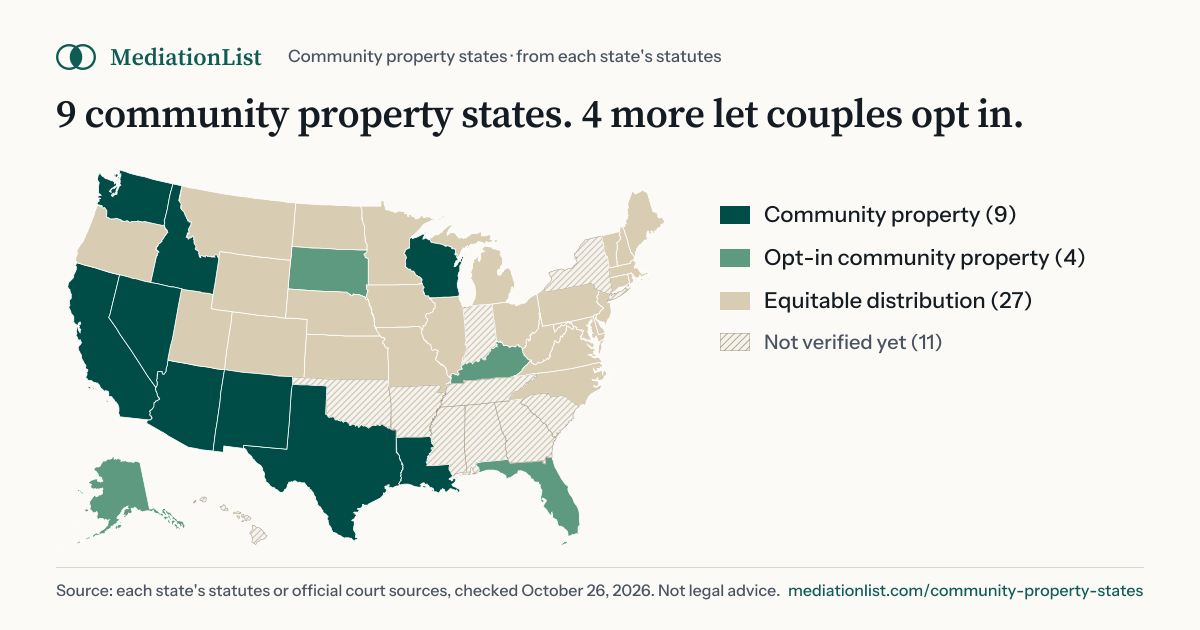
Arizona, California, Idaho, Louisiana, Nevada, New Mexico, Texas, Washington and Wisconsin are community property states under their own statutes.[2–39] Alaska, Florida, Kentucky and South Dakota divide property equitably but let couples opt in to community property by trust or agreement.[1–32] The other 27 verified jurisdictions use equitable distribution.[4–40]
Key facts
| Community property | 9 states · AZ, CA, ID, LA, NV, NM, TX, WA, WI |
|---|---|
| Equal split at divorce | The statute calls for it, at least by default, in 5 of the 9 |
| Opt-in by trust or agreement | 4 states · AK, FL, KY, SD |
| Equitable distribution | 27 verified · 11 not verified yet |
| Statutes last checked | October 26, 2026 |
Counts come from the state rows in the table below, each cited to the state’s property statute (listed under Sources).
- Community property
- 9
- Opt-in community property
- 4
- Equitable distribution
- 27
- Not verified yet
- 11
AZ · CA · ID · LA · NV · NM · TX · WA · WI
AK · FL · KY · SD: equitable unless a couple opts in
Divided fairly, not necessarily equally
Official text we couldn’t read; each page links it
Beyond the nine community property states, four more let couples opt in by trust or agreement
Everywhere else we verified (27 states), a court divides marital property by equitable distribution: fairly, not necessarily equally. Select a state to read its statute.
- Community property (9)
- Opt-in community property (4)
- Equitable distribution (27)
- Not verified yet (11)
Tap a state to see its rule; tap again to open its page.
40 of 51 jurisdictions verified from the official statute text; 11 not yet (Alabama, Arkansas, District of Columbia, Georgia, Hawaii, Indiana, Mississippi, New York, Oklahoma, South Carolina and Tennessee).
Source: each state's statutes, quoted and linked on its page (where the statute text couldn't be read, an official court source, labelled as such); checked October 26, 2026. Not legal advice.
Data as of (version 2026.10.28)What changedStatutes as checked on that date. Not legal advice.
Data as of = when the sources were read · Version = the data release · Page updated = the last change to this page
The nine community property states
Community property doesn’t always mean a 50/50 split: five of the nine states’ statutes call for an equal division at divorce, at least by default; the others leave the split to the court’s judgment or set no rule.
Arizona
Equitable division of community property
California
Equal division of community property
Judicial Branch of California self-help guide, “Property and debts”
Idaho
Substantially equal division unless compelling reasons
Louisiana
Equal division (equal net value)
Nevada
Equal division (unless compelling reason)
New Mexico
No division rule in the statute
Texas
Just and right division
Washington
Just and equitable division
Wisconsin
Equal division presumed
Four states let couples opt in to community property
They divide property equitably by default, but a statute lets spouses make chosen assets community property, usually by placing them in a community property trust. What each law allows:
| State | How | What the statute allows | Statute |
|---|---|---|---|
| Alaska | Agreement or trust | Spouses domiciled in Alaska may classify property as community property in a signed community property agreement; spouses anywhere (whether both, one or neither lives in Alaska) may do so through a community property trust, which needs at least one Alaska-based qualified trustee (an Alaska resident, or an Alaska trust company or bank) and must be signed by both spouses. | AS 34.77.060, 34.77.100 |
| Florida | Trust | Spouses may classify property as community property only by transferring it to a community property trust signed by both spouses. The trust must have at least one qualified trustee (a Florida resident or a company authorized to act as trustee in Florida); either or both spouses may also serve. Spouses need not live in Florida. | Fla. Stat. §§ 736.1503, 736.1505 |
| Kentucky | Trust | Spouses (whether both, one or neither lives in Kentucky) may classify property as community property by transferring it to a trust that declares itself a Kentucky community property trust, is signed by both spouses, and has at least one qualified trustee (a Kentucky resident, or a bank or trust company authorized to act as trustee in Kentucky); either or both spouses may also be trustee. On divorce the trust ends and each spouse receives half of each asset unless both agree otherwise in writing. | KRS 386.620-386.624 |
| South Dakota | Trust | Spouses may classify any or all of their property as special spousal (community) property by transferring it to a South Dakota special spousal trust that expressly declares it community property; the trust must be signed by both spouses, and at least one trustee must be a qualified person (a South Dakota resident individual, or a trust company or bank with its principal place of business in South Dakota). The statute does not limit the trust to South Dakota residents. | SDCL §§ 55-17-1, 55-17-3 |
Statutes read October 26, 2026. Each state page quotes the text.
Property division at divorce, state by state
From each state’s statute. “Not verified yet” means we couldn’t read the official text; the state page links to it.
| State | System | How a court divides property | Source |
|---|---|---|---|
| Alabama | Not verified yet; see the official text → | ||
| Alaska[1] | Opt-in community property | Just division (court weighs listed factors) | AS 25.24.160(a)(4) |
| Arizona[2] | Community property | Equitable division of community property | A.R.S. § 25-318(A) |
| Arkansas | Not verified yet; see the official text → | ||
| California[3] | Community property | Equal division of community property | Judicial Branch of California self-help guide, “Property and debts” |
| Colorado[4] | Equitable distribution | Equitable distribution | C.R.S. § 14-10-113(1) |
| Connecticut[5] | Equitable distribution | Court weighs listed factors | Conn. Gen. Stat. § 46b-81(a) |
| Delaware[6] | Equitable distribution | Equitable distribution | 13 Del. C. § 1513(a) |
| District of Columbia | Not verified yet; see the official text → | ||
| Florida[7] | Opt-in community property | Equal division unless justified otherwise | Fla. Stat. § 61.075(1) |
| Georgia | Not verified yet; see the official text → | ||
| Hawaii | Not verified yet; see the official text → | ||
| Idaho[8] | Community property | Substantially equal division unless compelling reasons | Idaho Code § 32-712(1)(a) |
| Illinois[9] | Equitable distribution | Division in just proportions | 750 ILCS 5/503(d) |
| Indiana | Not verified yet; see the official text → | ||
| Iowa[10] | Equitable distribution | Equitable distribution | Iowa Code § 598.21(5) |
| Kansas[11] | Equitable distribution | Court weighs listed factorsOpt-in community property trust law signed in 2026 (HB 2590); effective date pending. 2026 Kan. HB 2590 | K.S.A. 23-2802(a) |
| Kentucky[12] | Opt-in community property | Division in just proportions | KRS 403.190(1) |
| Louisiana[13] | Community property | Equal division (equal net value) | La. R.S. 9:2801(A)(4)(b) |
| Maine[14] | Equitable distribution | Division in just proportions | 19-A M.R.S. § 953(1) |
| Maryland[15] | Equitable distribution | Court weighs listed factors | Md. Code, Family Law § 8-205(a)(1) |
| Massachusetts[16] | Equitable distribution | Court weighs listed factors | Mass. Gen. Laws c. 208, § 34 |
| Michigan[17] | Equitable distribution | Just and reasonable division | MCL 552.19 |
| Minnesota[18] | Equitable distribution | Just and equitable division | Minn. Stat. § 518.58, subd. 1 |
| Mississippi | Not verified yet; see the official text → | ||
| Missouri[19] | Equitable distribution | Division in just proportions | RSMo § 452.330.1 |
| Montana[20] | Equitable distribution | Equitable distribution | Mont. Code Ann. § 40-4-202(1) |
| Nebraska[21] | Equitable distribution | Equitable distribution | Neb. Rev. Stat. § 42-365 |
| Nevada[22] | Community property | Equal division (unless compelling reason) | NRS 125.150(1)(b) |
| New Hampshire[23] | Equitable distribution | Equal division presumed | N.H. Rev. Stat. Ann. § 458:16-a(II) |
| New Jersey[24] | Equitable distribution | Equitable distribution | N.J.S.A. 2A:34-23(h), as set out in P.L.2014, c.42 |
| New Mexico[25] | Community property | No division rule in the statute | NMSA 1978, § 40-3-8(B) |
| New York | Not verified yet; see the official text → | ||
| North Carolina[26] | Equitable distribution | Equal division unless not equitable | N.C. Gen. Stat. § 50-20(c) |
| North Dakota[27] | Equitable distribution | Equitable distribution | N.D.C.C. § 14-05-24(1) |
| Ohio[28] | Equitable distribution | Equal division unless inequitable | R.C. 3105.171(C)(1), as quoted in Shupe v. Shupe, 2017-Ohio-5864 |
| Oklahoma | Not verified yet; see the official text → | ||
| Oregon[29] | Equitable distribution | Just and proper division | ORS 107.105(1)(f) |
| Pennsylvania[30] | Equitable distribution | Equitable distribution | 23 Pa.C.S. § 3502(a) |
| Rhode Island[31] | Equitable distribution | Court weighs listed factors | R.I. Gen. Laws § 15-5-16.1(a) |
| South Carolina | Not verified yet; see the official text → | ||
| South Dakota[32] | Opt-in community property | Equitable distribution | SDCL § 25-4-44 |
| Tennessee | Not verified yet; see the official text → | ||
| Texas[33] | Community property | Just and right division | Tex. Fam. Code § 7.001 |
| Utah[34] | Equitable distribution | Equitable distribution | Utah Code § 81-4-406(4) |
| Vermont[35] | Equitable distribution | Equitable distribution | 15 V.S.A. § 751(a) |
| Virginia[36] | Equitable distribution | Court weighs listed factors | Va. Code § 20-107.3 |
| Washington[37] | Community property | Just and equitable division | RCW 26.09.080 |
| West Virginia[38] | Equitable distribution | Equal division (adjustments allowed) | W. Va. Code § 48-7-101 |
| Wisconsin[39] | Community property | Equal division presumed | Wis. Stat. § 767.61(3) |
| Wyoming[40] | Equitable distribution | Just and equitable division | Wyo. Stat. § 20-2-114(a) |
Questions about community property
Which states are community property states?
Arizona, California, Idaho, Louisiana, Nevada, New Mexico, Texas, Washington and Wisconsin. In each, a statute makes property either spouse acquires during the marriage community property, subject to the exceptions it lists. Alaska, Florida, Kentucky and South Dakota let couples choose community property for assets they place in a qualifying trust or agreement; otherwise they divide property equitably. — Each state's statute, linked in the table above
What counts as community property?
Each state defines it in its own words. Texas's statute, for example: “Community property consists of the property, other than separate property, acquired by either spouse during marriage.” And separate property: “A spouse's separate property consists of: (1) the property owned or claimed by the spouse before marriage; (2) the property acquired by the spouse during marriage by gift, devise, or descent; and (3) the recovery for personal injuries sustained by the spouse during marriage, except any recovery for loss of earning capacity during marriage.” Each state page quotes its own definitions. — Tex. Fam. Code § 3.002; Tex. Fam. Code § 3.001, checked October 26, 2026
Is community property always split 50/50 in a divorce?
Not in every community property state. What each statute says about dividing it at divorce: Arizona, equitable division of community property; California, equal division of community property; Idaho, substantially equal division unless compelling reasons; Louisiana, equal division (equal net value); Nevada, equal division (unless compelling reason); New Mexico, no division rule in the statute; Texas, just and right division; Washington, just and equitable division; Wisconsin, equal division presumed. — Each state's division statute, quoted on its page
Can couples in other states opt into community property?
Yes, in Alaska, Florida, Kentucky and South Dakota. Alaska: Spouses domiciled in Alaska may classify property as community property in a signed community property agreement; spouses anywhere (whether both, one or neither lives in Alaska) may do so through a community property trust, which needs at least one Alaska-based qualified trustee (an Alaska resident, or an Alaska trust company or bank) and must be signed by both spouses. Florida: Spouses may classify property as community property only by transferring it to a community property trust signed by both spouses. The trust must have at least one qualified trustee (a Florida resident or a company authorized to act as trustee in Florida); either or both spouses may also serve. Spouses need not live in Florida. Kentucky: Spouses (whether both, one or neither lives in Kentucky) may classify property as community property by transferring it to a trust that declares itself a Kentucky community property trust, is signed by both spouses, and has at least one qualified trustee (a Kentucky resident, or a bank or trust company authorized to act as trustee in Kentucky); either or both spouses may also be trustee. On divorce the trust ends and each spouse receives half of each asset unless both agree otherwise in writing. South Dakota: Spouses may classify any or all of their property as special spousal (community) property by transferring it to a South Dakota special spousal trust that expressly declares it community property; the trust must be signed by both spouses, and at least one trustee must be a qualified person (a South Dakota resident individual, or a trust company or bank with its principal place of business in South Dakota). The statute does not limit the trust to South Dakota residents. — AS 34.77.060, 34.77.100; Fla. Stat. §§ 736.1503, 736.1505; KRS 386.620-386.624; SDCL §§ 55-17-1, 55-17-3
Use this map
Free to reuse under CC BY 4.0. Required attribution: MediationList.com
, with a link to this page.
The embed shows the map as an image linked back here.
Sources
Each state’s property statutes, read on the official site (or, where noted on the state page, an official court source), with the date we checked them.
- Alaska: Division at divorce: AS 25.24.160(a)(4) (Alaska Legislature); Opt-in: AS 34.77.060, 34.77.100 (Alaska Legislature)↩
- Arizona: Division at divorce: A.R.S. § 25-318(A) (Arizona Legislature); Marital or community property: A.R.S. § 25-211(A) (Arizona Legislature); Separate property: A.R.S. § 25-213(A) (Arizona Legislature)↩
- California: Division at divorce, Marital or community property, Separate property: Judicial Branch of California self-help guide, "Property and debts" (California Courts Self-Help Guide)↩
- Colorado: Division at divorce, Marital or community property, Separate property: C.R.S. § 14-10-113(1) (Colorado Revised Statutes 2024, Office of Legislative Legal Services)↩
- Connecticut: Division at divorce: Conn. Gen. Stat. § 46b-81(a) (Connecticut General Assembly)↩
- Delaware: Division at divorce, Marital or community property, Separate property: 13 Del. C. § 1513(a) (Delaware Code Online)↩
- Florida: Division at divorce, Marital or community property, Separate property: Fla. Stat. § 61.075(1) (Online Sunshine, Florida Legislature); Opt-in: Fla. Stat. §§ 736.1503, 736.1505 (Community Property Trust Act, Online Sunshine)↩
- Idaho: Division at divorce: Idaho Code § 32-712(1)(a) (Idaho Legislature); Marital or community property: Idaho Code § 32-906(1) (Idaho Legislature); Separate property: Idaho Code § 32-903 (Idaho Legislature)↩
- Illinois: Division at divorce, Marital or community property, Separate property: 750 ILCS 5/503(d) (Illinois General Assembly)↩
- Iowa: Division at divorce, Separate property: Iowa Code § 598.21(5) (Iowa Legislature)↩
- Kansas: Division at divorce: K.S.A. 23-2802(a) (Kansas Legislature); Marital or community property: K.S.A. 23-2801 (Kansas Legislature)↩
- Kentucky: Division at divorce, Marital or community property, Separate property: KRS 403.190(1) (Kentucky General Assembly); Opt-in: KRS 386.620-386.624 (Kentucky General Assembly)↩
- Louisiana: Division at divorce: La. R.S. 9:2801(A)(4)(b) (Louisiana State Legislature); Marital or community property: La. Civ. Code art. 2338 (Louisiana State Legislature); Separate property: La. Civ. Code art. 2341 (Louisiana State Legislature)↩
- Maine: Division at divorce, Marital or community property, Separate property: 19-A M.R.S. § 953(1) (Maine Legislature)↩
- Maryland: Division at divorce: Md. Code, Family Law § 8-205(a)(1) (Maryland General Assembly); Marital or community property, Separate property: Md. Code, Family Law § 8-201(e)(1) (Maryland General Assembly)↩
- Massachusetts: Division at divorce: Mass. Gen. Laws c. 208, § 34 (Massachusetts Legislature)↩
- Michigan: Division at divorce: MCL 552.19 (Michigan Legislature)↩
- Minnesota: Division at divorce: Minn. Stat. § 518.58, subd. 1 (Minnesota Revisor of Statutes); Marital or community property, Separate property: Minn. Stat. § 518.003, subd. 3b (Minnesota Revisor of Statutes)↩
- Missouri: Division at divorce, Marital or community property, Separate property: RSMo § 452.330.1 (Missouri Revisor of Statutes)↩
- Montana: Division at divorce: Mont. Code Ann. § 40-4-202(1) (Montana Legislature)↩
- Nebraska: Division at divorce: Neb. Rev. Stat. § 42-365 (Nebraska Legislature)↩
- Nevada: Division at divorce: NRS 125.150(1)(b) (Nevada Legislature); Marital or community property, Separate property: NRS 123.220 (Nevada Legislature)↩
- New Hampshire: Division at divorce: N.H. Rev. Stat. Ann. § 458:16-a(II) (New Hampshire General Court)↩
- New Jersey: Division at divorce: N.J.S.A. 2A:34-23(h), as set out in P.L.2014, c.42 (New Jersey Legislature)↩
- New Mexico: Marital or community property, Separate property: NMSA 1978, § 40-3-8(B) (NMOneSource, New Mexico Compilation Commission)↩
- North Carolina: Division at divorce, Marital or community property, Separate property: N.C. Gen. Stat. § 50-20(c) (North Carolina General Assembly)↩
- North Dakota: Division at divorce: N.D.C.C. § 14-05-24(1) (North Dakota Legislative Branch)↩
- Ohio: Division at divorce, Marital or community property: R.C. 3105.171(C)(1), as quoted in Shupe v. Shupe, 2017-Ohio-5864 (Supreme Court of Ohio opinions site)↩
- Oregon: Division at divorce: ORS 107.105(1)(f) (Oregon State Legislature)↩
- Pennsylvania: Division at divorce, Marital or community property, Separate property: 23 Pa.C.S. § 3502(a) (Pennsylvania General Assembly)↩
- Rhode Island: Division at divorce: R.I. Gen. Laws § 15-5-16.1(a) (State of Rhode Island General Assembly)↩
- South Dakota: Division at divorce: SDCL § 25-4-44 (South Dakota Legislature); Opt-in: SDCL §§ 55-17-1, 55-17-3 (South Dakota Legislature)↩
- Texas: Division at divorce: Tex. Fam. Code § 7.001 (Texas Constitution and Statutes); Marital or community property, Separate property: Tex. Fam. Code § 3.002 (Texas Constitution and Statutes)↩
- Utah: Division at divorce: Utah Code § 81-4-406(4) (Utah State Legislature)↩
- Vermont: Division at divorce: 15 V.S.A. § 751(a) (Vermont General Assembly)↩
- Virginia: Division at divorce, Marital or community property, Separate property: Va. Code § 20-107.3 (Virginia Law, Legislative Information System)↩
- Washington: Division at divorce: RCW 26.09.080 (Washington State Legislature); Marital or community property: RCW 26.16.030 (Washington State Legislature); Separate property: RCW 26.16.010 (Washington State Legislature)↩
- West Virginia: Division at divorce: W. Va. Code § 48-7-101 (West Virginia Legislature); Marital or community property: W. Va. Code § 48-1-233 (West Virginia Legislature); Separate property: W. Va. Code § 48-1-237 (West Virginia Legislature)↩
- Wisconsin: Division at divorce: Wis. Stat. § 767.61(3) (Wisconsin State Legislature); Marital or community property, Separate property: Wis. Stat. § 766.31(1) (Wisconsin State Legislature)↩
- Wyoming: Division at divorce: Wyo. Stat. § 20-2-114(a) (Wyoming Legislature)↩
Cite this page
MediationList. (2026). Community property states [Map]. Retrieved October 29, 2026, from https://mediationlist.com/community-property-states/
APA 7th ed. A retrieval date is included only for pages whose content changes, such as maps, data and tools.
This page summarizes state statutes for general information. It is not legal advice: laws change, how property is classified depends on the facts (when and how it was acquired, and any agreement between spouses), and courts apply the law case by case. Check the linked official source or ask a lawyer licensed in your state. See also divorce laws by state.