
Skip to content

Infographic

Mediation vs. court, side by side

How a divorce or custody case moves down each path, where they meet, and how they differ on who decides, privacy, cost and time. Built from family-court rules, court self-help pages and statutes, plus the rates courts post for their family mediators.
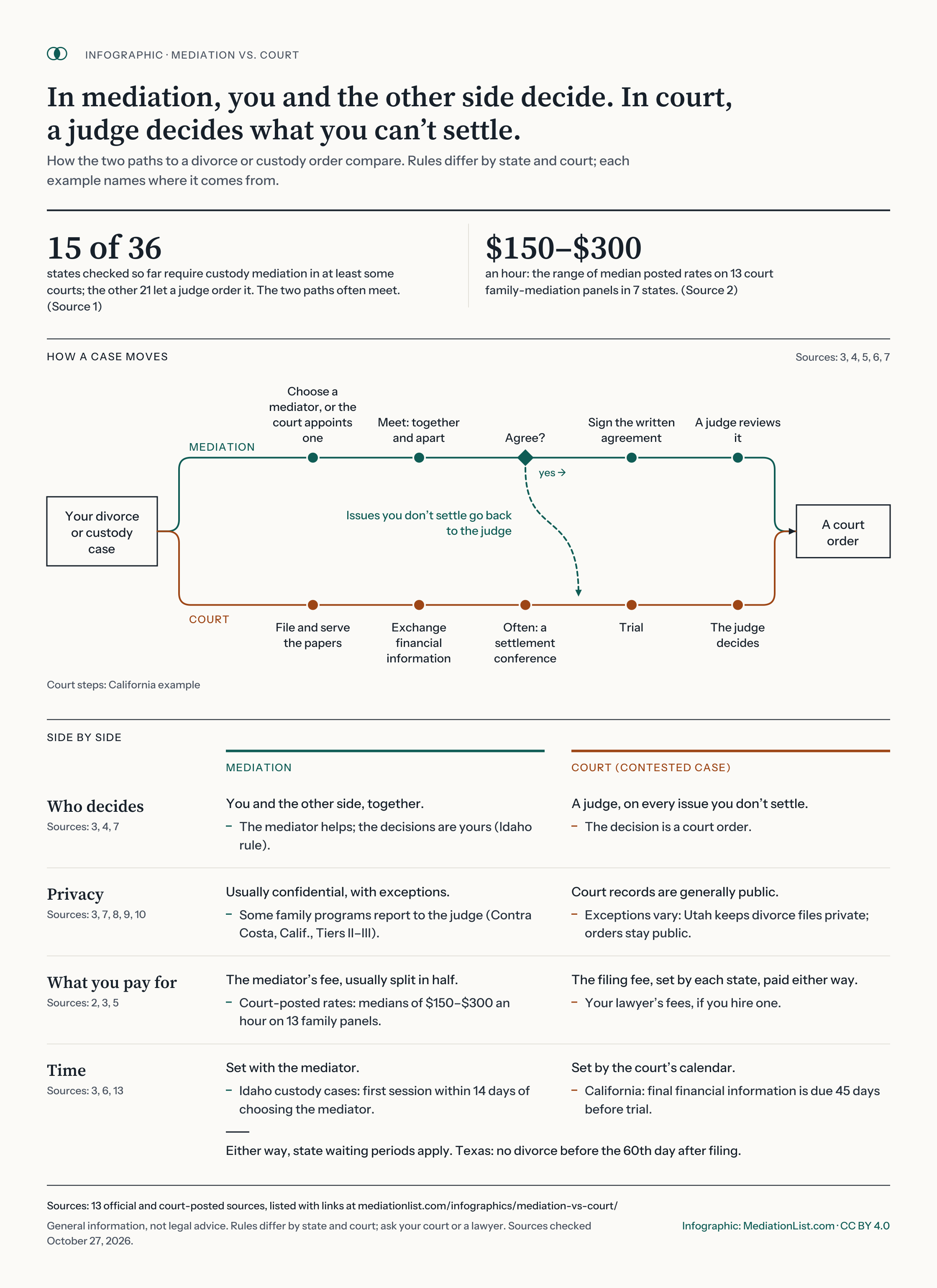
INFOGRAPHIC · MEDIATION VS. COURTIn mediation, you and theother side decide. In court, ajudge decides what you can’tsettle.How the two paths to a divorce or custodyorder compare. Rules differ by state andcourt; each example names where it comesfrom.15 of 36states checked so far require custodymediation in at least some courts; the other 21let a judge order it. The two paths often meet.(Source 1)$150–$300an hour: the range of median posted rates on 13court family-mediation panels in 7 states.(Source 2)HOW A CASE MOVESSources: 3, 4, 5, 6, 7Your divorce or custody caseMEDIATIONCOURTChoose a mediator,or the courtappoints oneFile and serve thepapersMeet: together andapartExchange financialinformationAgree?Often: a settlementconferenceIssues you don’tsettle go back to thejudgeSign the writtenagreementTrialA judge reviews itThe judge decidesA court orderCourt steps: California exampleSIDE BY SIDEWho decidesSources: 3, 4, 7MEDIATIONYou and the other side, together.The mediator helps; the decisions are yours(Idaho rule).COURTA judge, on every issue you don’t settle.The decision is a court order.PrivacySources: 3, 7, 8, 9, 10MEDIATIONUsually confidential, with exceptions.Some family programs report to the judge(Contra Costa, Calif., Tiers II–III).COURTCourt records are generally public.Exceptions vary: Utah keeps divorce filesprivate; orders stay public.What you pay forSources: 2, 3, 5MEDIATIONThe mediator’s fee, usually split in half.Court-posted rates: medians of $150–$300an hour on 13 family panels.COURTThe filing fee, set by each state, paid eitherway.Your lawyer’s fees, if you hire one.TimeSources: 3, 6, 13MEDIATIONSet with the mediator.Idaho custody cases: first session within 14days of choosing the mediator.COURTSet by the court’s calendar.California: final financial information is due45 days before trial.Either way, state waiting periods apply. Texas:no divorce before the 60th day after filing.General information, not legal advice. Rules differ bystate and court; ask your court or a lawyer. Sourceschecked October 27, 2026.Infographic: MediationList.comINFOGRAPHIC · MEDIATION VS. COURTIn mediation, you and the other side decide. Incourt, a judge decides what you can’t settle.How the two paths to a divorce or custody order compare. Rules differ by state andcourt; each example names where it comes from.15 of 36states checked so far require custodymediation in at least some courts; the other21 let a judge order it. The two paths oftenmeet. (Source 1)$150–$300an hour: the range of median posted rates on13 court family-mediation panels in 7 states.(Source 2)HOW A CASE MOVESSources: 3, 4, 5, 6, 7Your divorce or custody caseMEDIATIONCOURTChoose a mediator, or the court appointsoneFile and serve the papersMeet: together and apartExchange financial informationAgree?Often: a settlement conferenceIssues you don’t settle go back to the judgeSign the written agreementTrialA judge reviews itThe judge decidesA court orderCourt steps: California exampleSIDE BY SIDEMEDIATIONCOURT (CONTESTED CASE)Who decidesSources: 3, 4, 7You and the other side, together.The mediator helps; the decisions areyours (Idaho rule).A judge, on every issue you don’t settle.The decision is a court order.PrivacySources: 3, 7, 8, 9, 10Usually confidential, with exceptions.Some family programs report to thejudge (Contra Costa, Calif., Tiers II–III).Court records are generally public.Exceptions vary: Utah keeps divorce filesprivate; orders stay public.What you pay forSources: 2, 3, 5The mediator’s fee, usually split in half.Court-posted rates: medians of$150–$300 an hour on 13 family panels.The filing fee, set by each state, paideither way.Your lawyer’s fees, if you hire one.TimeSources: 3, 6, 13Set with the mediator.Idaho custody cases: first session within14 days of choosing the mediator.Set by the court’s calendar.California: final financial information isdue 45 days before trial.Either way, state waiting periods apply. Texas: no divorce before the 60th day after filing.General information, not legal advice. Rules differ by state and court;ask your court or a lawyer. Sources checked October 27, 2026.Infographic: MediationList.comINFOGRAPHIC · MEDIATION VS. COURTIn mediation, you and the other side decide. In court,a judge decides what you can’t settle.How the two paths to a divorce or custody order compare. Rules differ by state and court; eachexample names where it comes from.15 of 36states checked so far require custody mediation in at least somecourts; the other 21 let a judge order it. The two paths often meet.(Source 1)$150–$300an hour: the range of median posted rates on 13 courtfamily-mediation panels in 7 states. (Source 2)HOW A CASE MOVESSources: 3, 4, 5, 6, 7Your divorceor custodycaseA courtorderMEDIATIONCOURTChoose amediator, or thecourt appointsoneMeet: togetherand apartAgree?Sign the writtenagreementA judge reviewsitFile and servethe papersExchangefinancialinformationOften: asettlementconferenceTrialThe judgedecidesIssues you don’t settle go backto the judgeyes →Court steps: California exampleSIDE BY SIDEMEDIATIONCOURT (CONTESTED CASE)Who decidesSources: 3, 4, 7You and the other side, together.The mediator helps; the decisions are yours (Idahorule).A judge, on every issue you don’t settle.The decision is a court order.PrivacySources: 3, 7, 8, 9, 10Usually confidential, with exceptions.Some family programs report to the judge (ContraCosta, Calif., Tiers II–III).Court records are generally public.Exceptions vary: Utah keeps divorce files private;orders stay public.What you pay forSources: 2, 3, 5The mediator’s fee, usually split in half.Court-posted rates: medians of $150–$300 anhour on 13 family panels.The filing fee, set by each state, paid either way.Your lawyer’s fees, if you hire one.TimeSources: 3, 6, 13Set with the mediator.Idaho custody cases: first session within 14 days ofchoosing the mediator.Set by the court’s calendar.California: final financial information is due 45 daysbefore trial.Either way, state waiting periods apply. Texas: no divorce before the 60th day after filing.General information, not legal advice. Rules differ by state and court; ask your court or a lawyer. Sources checked October 27, 2026.Infographic: MediationList.com
Infographic: In mediation, you and the other side decide. In court, a judge decides what you can’t settle.How the two paths to a divorce or custody order compare. Rules differ by state and court; each example names where it comes from. The text version below has the same content.Download PNG · Embed · Text version · Sources

Sources

  1. MediationList, Divorce laws by state: Court mediation for custody: 36 states verified so far from each state’s statute or court rule. Checked October 26, 2026.
  2. MediationList, Divorce cost calculator, from each court’s published panel list: Hourly rates that 13 court family-mediation panels in 7 states (California, Illinois, Iowa, Michigan, Missouri, Ohio and Washington) post for their mediators; median of each list. Checked October 23, 2026. Lists read October 6, 2026 to October 23, 2026.
  3. Idaho Supreme Court: Idaho Rules of Family Law Procedure, Rule 602, Mediation of Child Custody and Visitation Disputes (amended eff. Jan. 1, 2026). Checked October 27, 2026.
  4. Colorado Judicial Branch: 4th Judicial District Mediation Office (El Paso and Teller Counties), “Frequently Asked Questions” (PDF). Checked October 27, 2026.
  5. California Courts Self-Help Guide: “Start a divorce case”. Checked October 27, 2026.
  6. California Courts Self-Help Guide: “Complete these steps before your divorce trial”. Checked October 27, 2026.
  7. California Courts Self-Help Guide: “Custody mediation in cases with domestic violence”. Checked October 27, 2026.
  8. Superior Court of California, County of Contra Costa: Family Court Services, “FAQs” (Tier I–III mediation). Checked October 27, 2026.
  9. Maryland Judiciary: “Access to Court Records”. Checked October 27, 2026.
  10. Utah State Courts: “Divorce” (Are my divorce records public?). Checked October 27, 2026.
  11. The Florida Senate: Fla. Stat. § 44.108(2)(a)–(b), Funding of mediation and arbitration. Checked October 27, 2026.
  12. Wisconsin State Legislature: Wis. Stat. § 814.615(1)(a), Fees for mediation and studies. Checked October 27, 2026.
  13. Texas Legislature: Tex. Fam. Code §§ 6.602 (mediation procedures) and 6.702 (waiting period). Checked October 27, 2026.

Official pages, rules and statutes were read in full on October 27, 2026. The panel rates and the custody-mediation count come from MediationList’s own pages, which cite each court list and statute. No official source publishes a national figure for what mediation or a court case costs or how long it takes, so those rows name a state instead of giving an average.

Text version

The same content as text, with the exact fee rules.
15 of 36
states checked so far require custody mediation in at least some courts; the other 21 let a judge order it. The two paths often meet. [1]
$150–$300
an hour: the range of median posted rates on 13 court family-mediation panels in 7 states. [2]

How a case moves [3, 4, 5, 6, 7]

Mediation

  1. Choose a mediator, or the court appoints one
  2. Meet: together and apart
  3. Agree? If yes, the agreement goes on to the judge. Issues you don’t settle go back to the judge.
  4. Sign the written agreement
  5. A judge reviews it

Court (contested case; California example)

  1. File and serve the papers
  2. Exchange financial information
  3. Often: a settlement conference
  4. Trial
  5. The judge decides

Both paths start with your divorce or custody case and end in a court order.

Mediation compared with a contested court case
TopicMediationCourt (contested case)
Who decides [3, 4, 7]
  • You and the other side, together.
  • The mediator helps; the decisions are yours (Idaho rule).
  • A judge, on every issue you don’t settle.
  • The decision is a court order.
Privacy [3, 7, 8, 9, 10]
  • Usually confidential, with exceptions.
  • Some family programs report to the judge (Contra Costa, Calif., Tiers II–III).
  • Court records are generally public.
  • Exceptions vary: Utah keeps divorce files private; orders stay public.
What you pay for [2, 3, 5]
  • The mediator’s fee, usually split in half.
  • Court-posted rates: medians of $150–$300 an hour on 13 family panels.
  • The filing fee, set by each state, paid either way.
  • Your lawyer’s fees, if you hire one.
Time [3, 6, 13]
  • Set with the mediator.
  • Idaho custody cases: first session within 14 days of choosing the mediator.
  • Set by the court’s calendar.
  • California: final financial information is due 45 days before trial.

Either way, state waiting periods apply. Texas: no divorce before the 60th day after filing.

Court mediation fees set by law (examples)

  • Florida circuit court family mediation: $60 per person per scheduled session if the parties’ combined income is under $50,000; $120 if it is $50,000 to $100,000. [11]
  • Wisconsin county family court mediation on referral: the first session is free; after that, one fee of $200 ($285 from Nov. 1, 2026), however many sessions, reduced by ability to pay. [12]

Read more

Talk it through with a court-listed mediator

A mediator is a neutral who helps you and your spouse reach your own agreement on property, support and parenting time. Every mediator we list comes from an official court or government roster, with the source on the profile.

Get matched — freeFind a mediator near you

Use this infographic

Free to share and embed under CC BY 4.0. Please keep the credit line, “Infographic: MediationList.com”, with its link to this page.

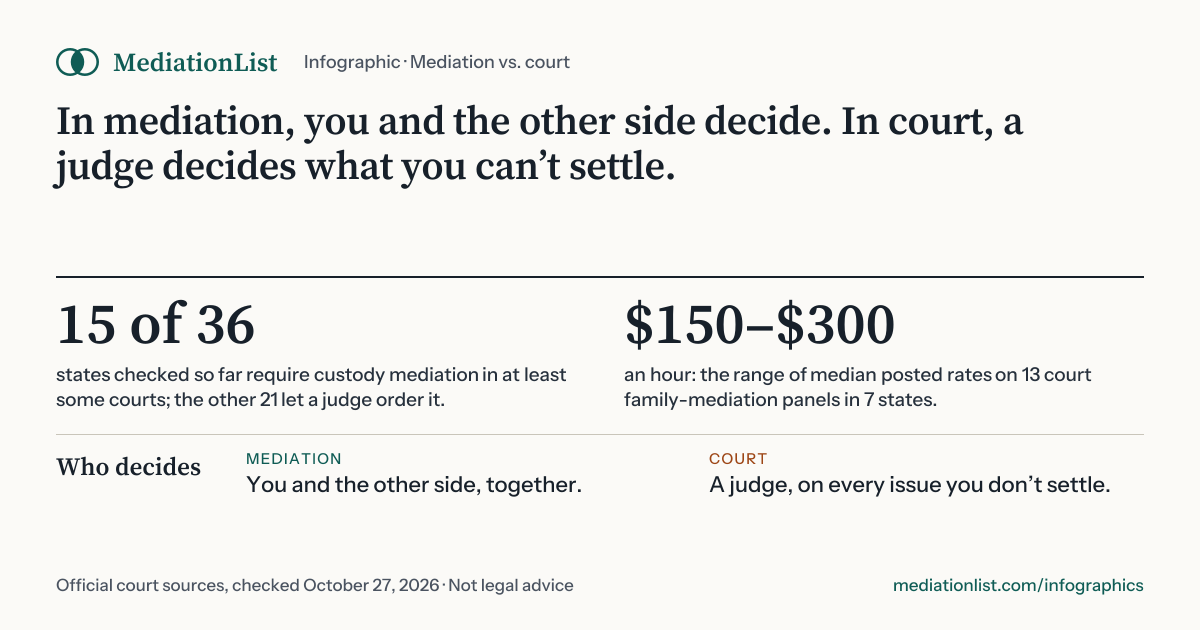
Download the mediation vs. court infographic (PNG, 2,240×3,078)Share image (PNG, 1200×630)
Cite this page

Page updated
Data version
2026.10.28

MediationList. (2026). Mediation vs. court, side by side [Infographic]. https://mediationlist.com/infographics/mediation-vs-court/

APA 7th ed. A retrieval date is included only for pages whose content changes, such as maps, data and tools.