
Infographic
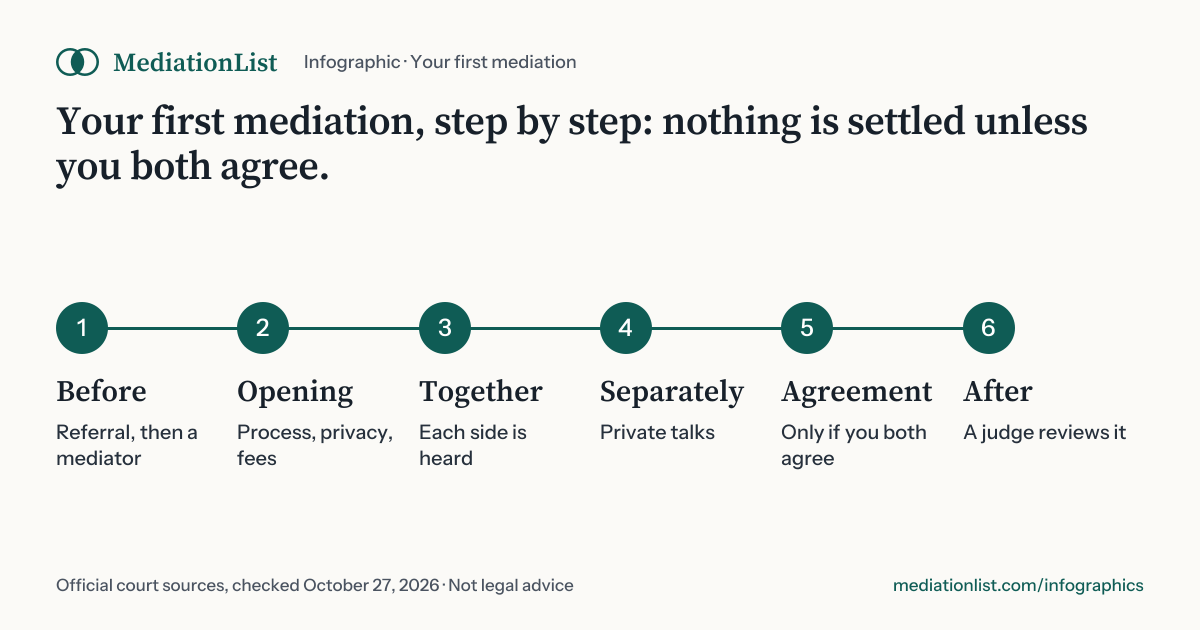
Your first mediation, step by step
What usually happens when a court sends your divorce or custody case to mediation: getting ready, the mediator’s opening, talking together and separately, the agreement, and what the judge does next. Drawn from family-court rules and court mediation programs.
Sources
- Idaho Supreme Court: Idaho Rules of Family Law Procedure, Rule 602, Mediation of Child Custody and Visitation Disputes (amended eff. Jan. 1, 2026). Checked October 27, 2026.
- California Courts Self-Help Guide: “Custody mediation in cases with domestic violence”. Checked October 27, 2026.
- Colorado Judicial Branch: 4th Judicial District Mediation Office (El Paso and Teller Counties), “Frequently Asked Questions” (PDF). Checked October 27, 2026.
- Superior Court of California, County of Contra Costa: Family Court Services, “FAQs” (Tier I–III mediation). Checked October 27, 2026.
- Texas Legislature: Tex. Fam. Code § 153.0071, Alternate dispute resolution procedures (custody suits). Checked October 27, 2026.
Each rule, statute and court page was read in full on October 27, 2026. Court programs run mediation in different ways, so the examples name the state or court they come from; your own court’s order and program rules are what apply to you.
Text version
The same steps as text, with the examples.
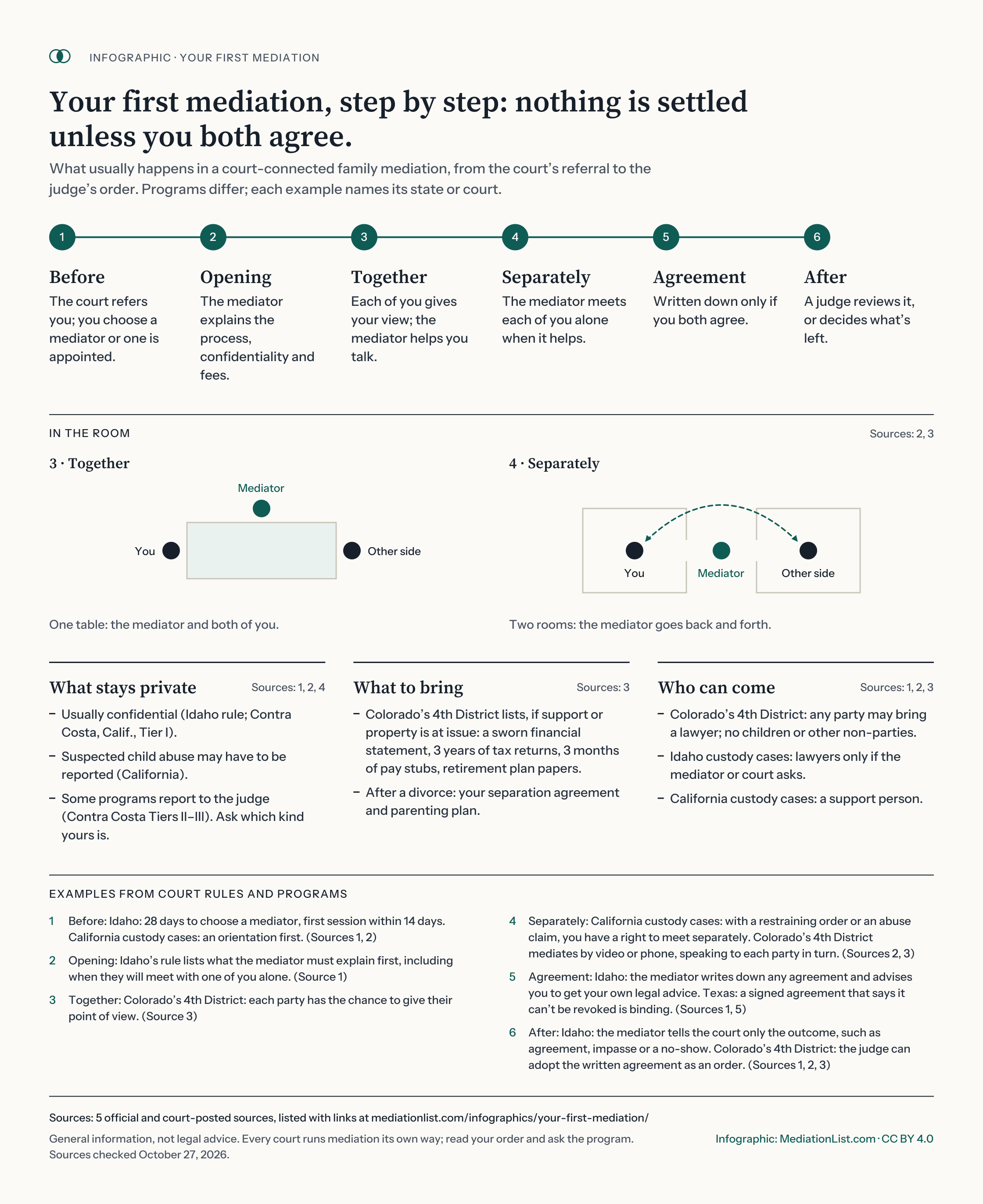
Before [1, 2]
The court refers you; you choose a mediator or one is appointed.
Example: Idaho: 28 days to choose a mediator, first session within 14 days. California custody cases: an orientation first.
Opening [1]
The mediator explains the process, confidentiality and fees.
Example: Idaho’s rule lists what the mediator must explain first, including when they will meet with one of you alone.
Together [3]
Each of you gives your view; the mediator helps you talk.
Example: Colorado’s 4th District: each party has the chance to give their point of view.
Separately [2, 3]
The mediator meets each of you alone when it helps.
Example: California custody cases: with a restraining order or an abuse claim, you have a right to meet separately. Colorado’s 4th District mediates by video or phone, speaking to each party in turn.
Agreement [1, 5]
Written down only if you both agree.
Example: Idaho: the mediator writes down any agreement and advises you to get your own legal advice. Texas: a signed agreement that says it can’t be revoked is binding.
After [1, 2, 3]
A judge reviews it, or decides what’s left.
Example: Idaho: the mediator tells the court only the outcome, such as agreement, impasse or a no-show. Colorado’s 4th District: the judge can adopt the written agreement as an order.
Together: One table: the mediator and both of you. Separately: Two rooms: the mediator goes back and forth.
What stays private [1, 2, 4]
- Usually confidential (Idaho rule; Contra Costa, Calif., Tier I).
- Suspected child abuse may have to be reported (California).
- Some programs report to the judge (Contra Costa Tiers II–III). Ask which kind yours is.
What to bring [3]
- Colorado’s 4th District lists, if support or property is at issue: a sworn financial statement, 3 years of tax returns, 3 months of pay stubs, retirement plan papers.
- After a divorce: your separation agreement and parenting plan.
Read more
Use this infographic
Free to share and embed under CC BY 4.0. Please keep the credit line, “Infographic: MediationList.com”, with its link to this page.
Download the your first mediation infographic (PNG, 2,240×2,744)Share image (PNG, 1200×630)
General information, not legal advice. Every court runs mediation its own way; read your order and ask the program or a lawyer about your case. All infographics
Cite this page
MediationList. (2026). Your first mediation, step by step [Infographic]. https://mediationlist.com/infographics/your-first-mediation/
APA 7th ed. A retrieval date is included only for pages whose content changes, such as maps, data and tools.